
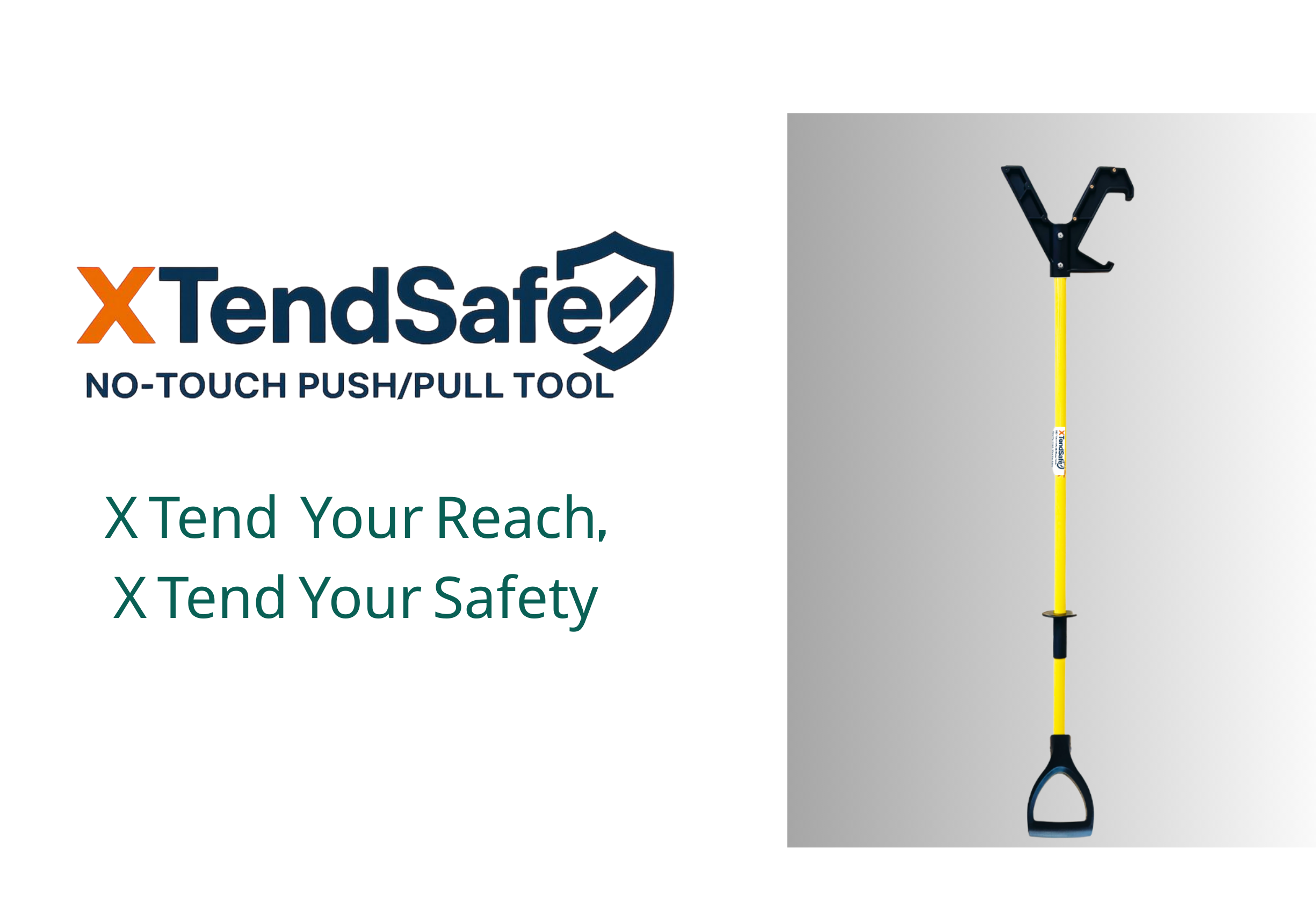
Xtend Safe No‑Touch Push‑Pull Tool
Xtend Your Reach. Xtend Your Safety.
Product Overview :
The Xtend Safe No‑Touch Push‑Pull Tool is a purpose‑built hand safety and load‑control tool designed to eliminate direct hand contact during pushing, pulling, guiding, and alignment tasks. Used across rigging, maintenance, shutdowns, material handling, and industrial installation, Xtend Safe™ helps prevent hand injuries by extending the user’s reach and keeping hands completely out of pinch points, crush zones, and line‑of‑fire areas. This tool is not PPE. It is an engineering control.
Key Features & Benefits
1. No‑Touch Operation
Eliminates direct hand contact with moving or unstable objects
Keeps hands outside pinch and crush zones
Reduces last‑second reaction injuries
2. Extended Reach Design
Maintains a minimum 600 mm (2‑foot) safety distance
Improves control without stepping closer to the hazard
Allows safer positioning during final alignment
3. Controlled Push & Pull
Designed for directional control, not lifting
Enables smooth, incremental movement
Prevents sudden hand placement during landing
4.Industrial‑Grade Construction
Built for refinery, petrochemical, and heavy‑industry environments
Durable shaft and handle for high‑use applications
Designed for predictable performance under load
5. Ergonomic & Field‑Ready
Reduces wrist strain and over‑reaching
Improves balance and body positioning
Safer than pipes, rods, or improvised tools
Typical Applications
Xtend Safe No‑Touch Push‑Pull Tool is commonly used for:
Load positioning during rigging operations
Final alignment of equipment, skids, and panels
Guiding loads during landing
Material handling near fixed structures
Maintenance and shutdown activities
Working around rollers, conveyors, and moving parts
Anywhere hands are at risk, Xtend Safe applies.
Why Xtend Safe No‑Touch Push‑Pull Tool
Most serious hand injuries don’t happen during lifting — they happen when workers reach in to guide or align loads.
Xtend Safe is designed for that exact moment.
Key Safety Principle: If hands are close enough to get hurt, they are too close.
Industry-Wise Usage Support
UNIVERSAL SAFE-USE RULES (ALL INDUSTRIES)
✅ DO (Mandatory Safe Practices)
Use the Xtend Safe No-Touch Push-Pull Tool only for directional control (push, pull, guide, align).
Maintain a minimum hand-to-hazard distance of 600 mm (2 ft) at all times.
Apply smooth, controlled force in line with the intended movement.
Ensure 100% load weight is supported by crane, hoist, rollers, or mechanical aids.
Maintain clear line-of-fire awareness and escape path.
Inspect tool integrity before use (shaft, handle, head engagement).
❌ DON’T (Critical Violations)
Do NOT use the tool to lift, support, stop, or hold load weight.
Do NOT hook the tool into slings, shackles, chains, or rigging gear.
Do NOT side-load, twist, or jerk the tool.
Do NOT step inside the pinch or crush zone “just for alignment”.
Do NOT substitute hands when resistance is felt—stop and re-adjust the job.
1️⃣ OIL & GAS / PETROCHEMICAL PLANTS
Typical Hazards
Pipe roll-over
Sudden COG shift
Oily, slippery surfaces
Congested pipe racks
✅ DO
Use the Xtend Safe No-Touch Push-Pull Tool for pipe spool alignment and valve positioning.
Engage the load below its center of gravity to prevent roll.
Anticipate rotation when slings slacken during landing.
Keep feet clear of pipe movement paths.
Apply force parallel to pipe axis for predictable movement.
❌ DON’T
Do not try to stop rolling pipes with hands or feet.
Do not reach between pipe and rack for “last-inch” correction.
Do not push from the high side of an inclined surface.
HSC Rule:
If hands feel “almost safe,” they are already too close.
2️⃣ REFINERIES & SHUTDOWN / TURNAROUND OPERATIONS
Typical Hazards
Time pressure
Temporary structures
Simultaneous operations (SIMOPS)
✅ DO
Use Xtend Safe during final positioning, not only during lifting.
Maintain extended reach when working near fixed steel, supports, or foundations.
Coordinate tool use with lift supervisor and banksman.
Use incremental movements during congested alignment.
❌ DON’T
Don’t rush alignment due to shutdown pressure.
Don’t place hands inside skid or frame boundaries.
Don’t apply force while body balance is compromised.
Engineering Control Principle:
Xtend Safe replaces instinctive hand reach during high-risk moments.
3️⃣ POWER PLANTS (THERMAL, HYDRO, NUCLEAR)
Typical Hazards
Tight tolerances
High-value equipment
Fixed foundation pinch points
✅ DO
Use the Xtend Safe No-Touch Push-Pull Tool during turbine, pump, and motor alignment.
Keep tool face square to the load to prevent sudden slip.
Stop immediately if resistance increases—signal mechanical adjustment.
❌ DON’T
Don’t force alignment manually.
Don’t stand between load and foundation.
Don’t place hands under base plates or skids.
HSC Insight:
Most power-plant hand injuries occur after the lift, during alignment.
4️⃣ CONSTRUCTION & PRECAST YARDS
Typical Hazards
Swinging loads
Uneven ground
Rebar pinch points
✅ DO
Use Xtend Safe to control swing before landing, not after.
Maintain distance while guiding beams, panels, or cages.
Position body outside the drop zone.
❌ DON’T
Don’t “catch” drifting loads with hands.
Don’t stand downhill of heavy components.
Don’t push perpendicular to beam length.
Extend Your Reach. Extend Your Safety.
Distance is the primary control.
5️⃣ MARINE, SHIPYARDS & OFFSHORE
Typical Hazards
Wind load
Vessel motion
Wet, slippery decks
✅ DO
Use longer reach to counter wind-induced drift safely.
Apply force gradually, accounting for deck movement.
Keep body positioned upwind and out of line-of-fire.
❌ DON’T
Don’t fight wind with body strength.
Don’t stand between suspended load and fixed structure.
Don’t over-correct swing—small inputs only.
Offshore Rule:
If body weight is needed, the method is unsafe.
6️⃣ MATERIAL HANDLING, WAREHOUSES & MAINTENANCE
Typical Hazards
Rollers and conveyors
Moving parts
Fixed structure pinch points
✅ DO
Use Xtend Safe when guiding loads near rollers or conveyors.
Maintain reach while aligning pallets, crates, or equipment.
Keep hands out of shear and nip points.
❌ DON’T
Don’t reach between moving and fixed parts.
Don’t use pipes, rods, or scrap as substitutes.
Don’t guide unstable loads without mechanical support.
Size Options
Choose from a range of sizes designed to meet varied application needs:
21″ | 42″ | 50″ | 72″ | 96″
Each size is engineered to maintain consistent performance and quality across all variants.
Frequently Asked Questions
1. What does “Xtend Your Reach. Xtend Your Safety.” actually mean on site?
It means distance equals protection.
Your hands stay away from pinch and crush points
You stay out of the line of fire
You control the job without risking fingers
In rigging and material handling, the closer your hands are, the higher the risk.
2. What is a no‑touch push‑pull tool used for?
A no‑touch push‑pull tool is used to:
Increase the distance between hands and hazards
Push, pull, guide, or align objects without hand contact
Eliminate finger placement at pinch points and crush zones
XTEND SAFE tools are designed for reach extension + controlled force — not lifting or load holding.
3.How does a no‑touch push‑pull tool prevent hand and finger injuries?
They prevent injuries by:
Keeping hands completely outside the line of fire
Maintaining a minimum safe distance (typically ≥ 600 mm)
Allowing controlled movement without touching the load
Most serious hand injuries happen during final positioning — exactly where no‑touch tools are meant to be used.
4. When should a no‑touch push‑pull tool be used instead of hands?
Use a no‑touch push‑pull tool when:
Hands would enter a pinch or crush zone
Objects can shift, roll, or drop suddenly
Alignment is required near fixed structures
The object is hot, sharp, heavy, or unstable
5. Are no‑touch push‑pull tools load‑bearing or lifting devices?
No.
XTEND SAFE no‑touch tools:
Do not carry weight
Do not replace slings, cranes, or hoists
Are used only for directional control
All load weight must be supported by proper lifting equipment.
6. What hazards are no‑touch push‑pull tools designed to control?
Primary hazards include:
Pinch points
Crush zones
Line‑of‑fire injuries
Sharp edges
Hot surfaces
Unexpected load movement
Common use areas:
Rigging
Maintenance
Material handling
Shutdown and turnaround work
7. How far should hands be kept away for real safety?
Best practice is:
Minimum 600 mm (2 feet) from the hazard
More distance for heavy, unstable, or suspended loads
Xtend-reach tools create a physical safety buffer between hands and hazards.
8. What surfaces or materials can no-touch push-pull tools be used on?
Depending on tool head design:
Hook or claw tools work well on painted, oily, or irregular surfaces
Magnetic versions require clean ferrous surfaces
Correct tool selection must match the material and surface condition
Ready to Streamline Your Sourcing?
Facing challenges in procurement? Reach out, and let's solve them together.
Offices
Head Office
5th Floor 30-15-189, DABAGARDENS, VISAKHAPATNAM ANHDRA PRADESH
Email: info@techmroinc.com