
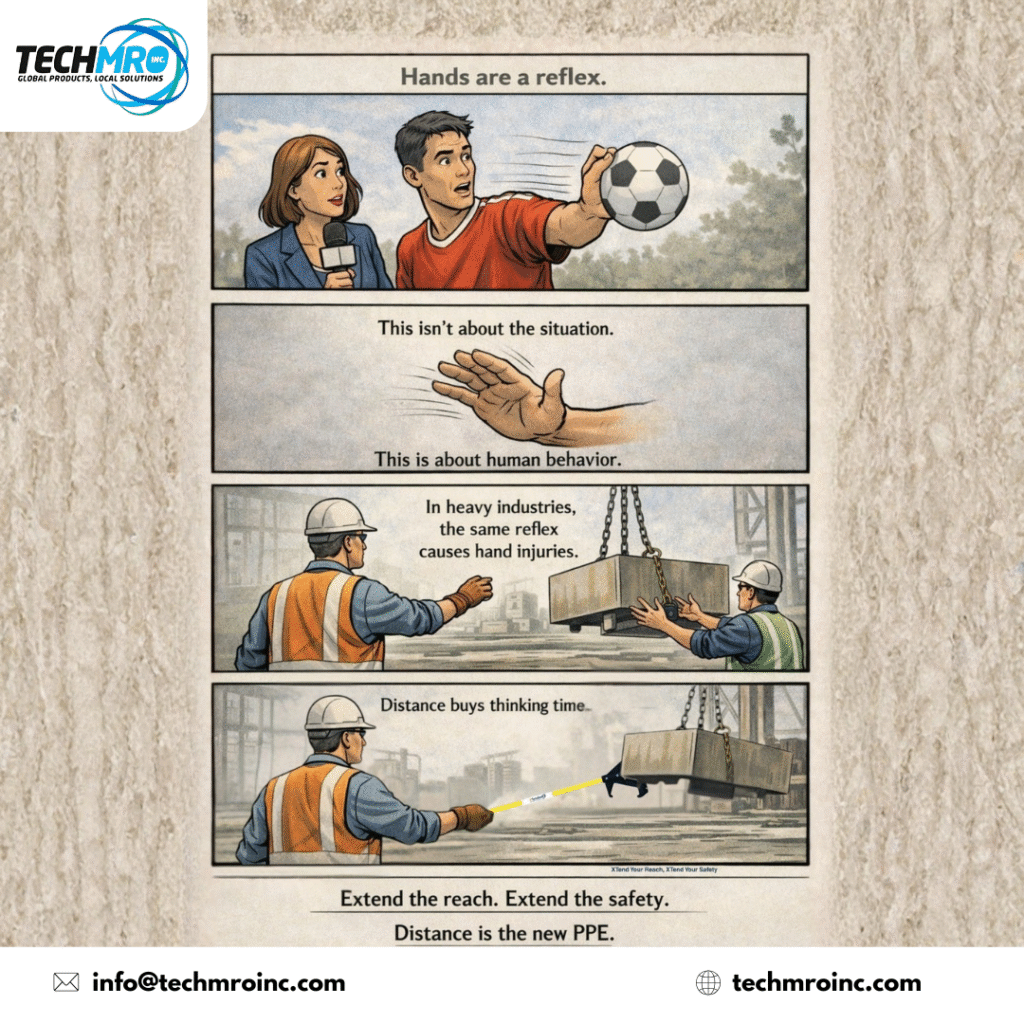
Hands Are a Reflex. Distance Is a Decision.
Most hand injuries don’t happen because workers are careless.
They happen because humans are wired to react.
When something suddenly moves toward us—falls, swings, shifts—our hands move before our brain finishes processing risk. It’s instinct. It’s reflex. And it’s universal.
That reflex saves us in everyday life.
In industrial environments, it puts us in danger.
Reflex Is Not a Training Problem
Watch someone stop a flying object mid-air. There’s no pause, no checklist, no conscious decision. The hand moves automatically.
Now take that same human reflex and place it under a suspended load, near a pinch point, or beside a shifting component.
The intent is always the same:
- “Just catch it.”
- “Just guide it.”
- “Just stop it from falling.”
The outcome is often very different.
This is why hand injuries persist even in highly trained, experienced teams. Skill and awareness don’t eliminate reflex. They coexist with it.
The Real Issue: Exposure, Not Effort
In heavy industries, injuries rarely occur during planned lifting or controlled motion. They happen in the unplanned moment the correction.
A load drifts.
Alignment feels off.
Something shifts unexpectedly.
Hands go in because that’s what humans do.
The problem isn’t that people reach.
The problem is that the environment allows hands to be close enough to reach in the first place.
Distance Buys Thinking Time
Distance changes everything.
When hands are physically removed from the line of fire:
- Reflex loses access to the hazard
- The brain gets time to assess
- Decisions replace instinct
This is the critical shift:
from reacting with the body to responding with control.
Distance doesn’t fight human behavior.
It designs around it.
Why Tools Matter More Than PPE Alone
Gloves protect hands after contact.
Engineering controls prevent contact altogether.
A no-touch push/pull tool isn’t PPE—it’s a behavioral barrier. It creates space between instinct and impact.
Instead of reaching in:
- The load is guided from a safe distance
- Alignment happens without exposure
- Control is maintained without sacrifice
The task still gets done.
The risk doesn’t.
Distance Is the New PPE
Modern safety isn’t about asking people to suppress reflexes. That’s unrealistic.
It’s about acknowledging how humans actually behave—and designing systems that keep them safe because of it.
Distance isn’t a weakness.
It’s an upgrade.
When reach is extended, safety follows.
Extend the reach. Extend the safety.
Distance is the new PPE.
Design distance into your tasks—before reflex takes over.
Explore how no-touch push-pull tools help eliminate hand exposure in industrial environments.
📧 info@techmroinc.com
🌐 techmroinc.com