When Hands Are Too Close to Danger: Extending Reach to Improve Safety in Foundries
A Smarter Approach to Hand Protection in Foundries and Forging Operations
In foundries and forging shops, hands work closer to danger than in almost any other industry.
Molten metal.
Red-hot billets.
Heavy dies. High-energy presses.
Despite advanced machinery, many critical tasks still require manual intervention—guiding, aligning, clearing, and positioning components where heat, weight, and motion intersect.
At Techmroinc, we believe modern foundry safety starts with one simple principle:
When you extend reach, you reduce risk. When you reduce risk, you enhance safety.
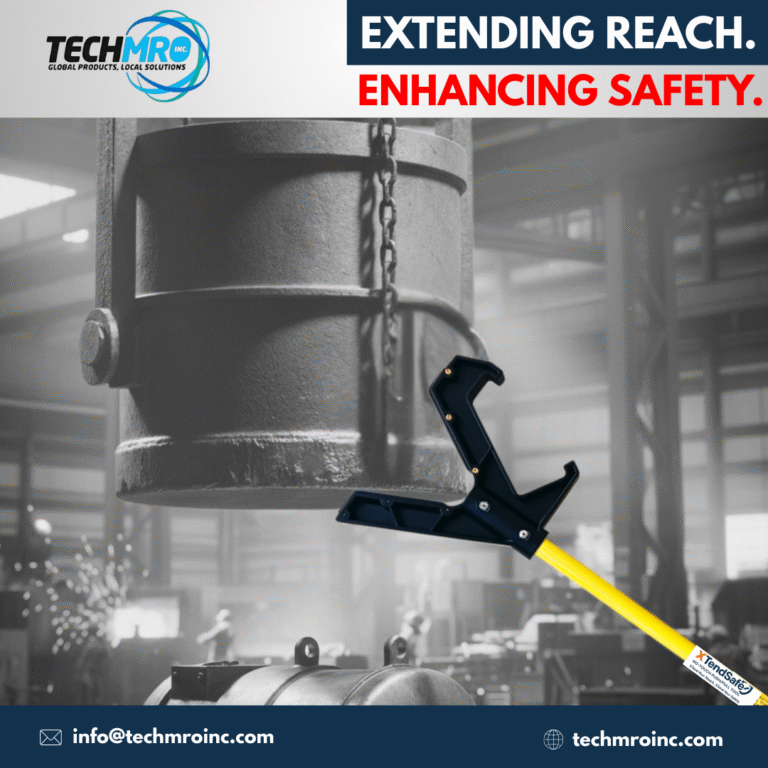
This is the foundation of our campaign: Extending Reach. Enhancing Safety.
.
Why Foundries and Forging Shops Are High-Risk for Hand Injuries
Foundry and forging environments expose workers to multiple injury mechanisms at once. Unlike typical manufacturing floors, hazards are layered and constant.
Common Hand Injury Risks in Foundries
Burns from hot metal, scale, and slag
Crush injuries from heavy forgings and dies
Pinch points near presses and manipulators
Impact injuries from misaligned components
Electrical risks near powered equipment
Even experienced operators face danger during short, routine actions—a slight adjustment, a quick push, or a momentary alignment.
In these environments, proximity is the real hazard.
The Limitation of PPE Alone
Heat-resistant gloves, gauntlets, and protective sleeves are essential. But PPE has a limit.
Gloves:
Do not stop heat transfer from prolonged contact
Do not prevent crush injuries
Do not slow down heavy moving components
Do not create distance from danger
PPE protects the hand after exposure. Engineering controls protect the hand by avoiding exposure altogether.
That is where reach-extending tools change the equation.
Extending Reach as an Engineering Control
In modern safety thinking, the safest action is the one that keeps the worker out of the hazard zone entirely.
Extending reach:
Reduces burn severity
Eliminates pinch and crush exposure
Improves control during alignment
Increases reaction time
Instead of using hands to guide hot or heavy components, tools become the point of contact.
This shift is fundamental to safer forging operations.
The Role of Forging Safety Tools
Forging safety tools are designed to replace hands during tasks such as:
Positioning hot billets
Aligning forgings on dies
Adjusting components near presses
Clearing minor obstructions
Guiding parts near furnaces
These tools allow operators to:
Maintain a safe working distance
Apply controlled force
Improve precision without exposure
In high-temperature, high-energy environments, distance equals protection.
Key Tool Features That Matter in Foundry Environments
Not all tools are suitable for forging applications. Foundry conditions demand specific design characteristics.
🔹 V-Shaped Nylon Head
The V-shaped nylon head provides secure engagement with round, flat, and irregular forgings. It improves stability during alignment while avoiding metal-to-metal contact that can damage surfaces or cause sparks.
🔹 D-Handle Design
The D-handle allows operators to apply push or pull force with proper wrist alignment, reducing fatigue and improving control—especially during repetitive tasks.
🔹 Center Grip for Precision
The center grip enables fine positioning in tight spaces near presses, dies, and furnaces where precision is critical and reaction time is limited.
🔹 Non-Conductive Construction
In foundries where electrical equipment, powered manipulators, and control systems are present, non-conductive tools add an extra layer of safety beyond heat and impact protection.
Each feature supports one goal: maximum control with minimum exposure.
Safety, Productivity, and Confidence Go Together
There is a common misconception that safety tools slow down production.
In reality:
Fewer injuries mean fewer disruptions
Better control improves alignment accuracy
Reduced hesitation increases operator confidence
Safer methods become faster methods over time
When operators trust their tools, they work more efficiently—not less.
Techmroinc’s Safety Philosophy
At Techmroinc, we don’t view safety as an accessory to production. We view it as a performance enabler.
Our approach is built on:
Engineering controls over reliance on PPE
Distance over direct contact
Prevention over reaction
Because the safest foundries are not the ones with the thickest gloves— they are the ones that keep hands out of danger in the first place.
Conclusion: A Smarter Way Forward for Foundries
Foundries and forging operations will always involve heat, weight, and force. But hand injuries are not inevitable.
By rethinking proximity and adopting forging safety tools that extend reach, foundries can protect their most valuable assets—their people.
Extending reach isn’t just about convenience. It’s about control. It’s about confidence. It’s about safety.

 Order Xtend Safe No-Touch Tools Today
 techmroinc@gmail.com
  techmroinc.com